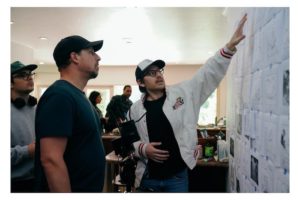
“Ultimately these projects are part of a bigger vision I’m building: creating worlds and universes- some for kids, some for adults- that all come from the same place of curiosity, wonder, trying to understand what it means to be human, and our place in the cosmos as we live through a major epoch change in society.” Author B.R. Duray (aka Matthew Thompson) talks about the short film based on the book The Mood Swing.
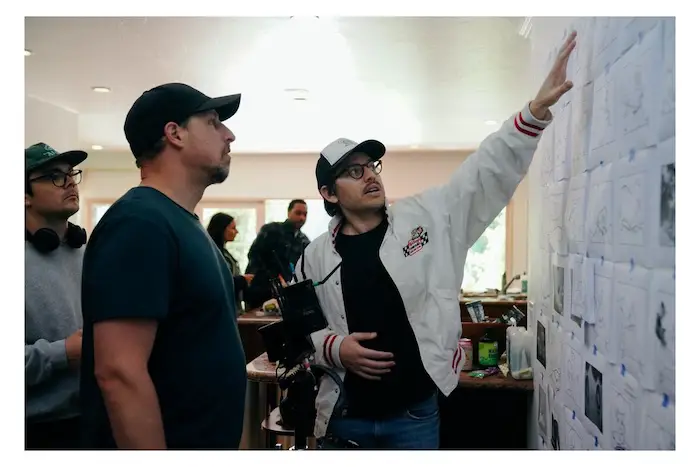
You are both the author of The Mood Swing picture book, and the director of the short film based on it. Did you originally conceptualize the book as a film?
Actually, yes. The Mood Swing began as an animated short film concept, but as the artistic process goes, the story kept evolving and sort of whispering to me that it needed to be expressed and absorbed in a more intimate way than a film alone. I realized the emotional journey at the heart of it might resonate more powerfully if it were something a parent and child could sit with together, hold in their hands, and revisit at their own pace.
So I wrote it as a picture book.
Ironically, creating the book ended up being two years of pre-production for a live-action film without me realizing it. Once the book existed, the film version became inevitable because I’m first and foremost a director and I think in moving images. The picture book became the “prop” from the world of the film, and suddenly the two mediums were speaking to each other. It was a full-circle moment, and a reminder that stories sometimes choose their own form, and creatives often just need to follow where they lead.

Did you encounter any unique challenges or surprises when adapting your own book into film? What was the adaptation process like?
The adaptation felt pretty natural. The Mood Swing universe already existed so clearly in my mind that adapting it felt like lifting one world and gently placing it inside another. I’m a platform-agnostic creator. I love building universes that can move between mediums: live action, books, animation, VR, immersive audio. I’ve played in all those sandboxes, and for me, the medium is just a different way to express an emotional truth.
The biggest surprise was how natural it felt to expand the book into a sensory cinematic experience. The colors, textures, and emotional beats were already encoded in the book’s DNA. Every film has its natural production challenges, but adapting it wasn’t so difficult as much as it was an evolution. I was able to bring to life not only the seed of the central story, but the emotional connection I hope parents and children can share around my story.
It really was like cooking different dishes with the same ingredients.
What is the premise of The Mood Swing? Why did you write this story?
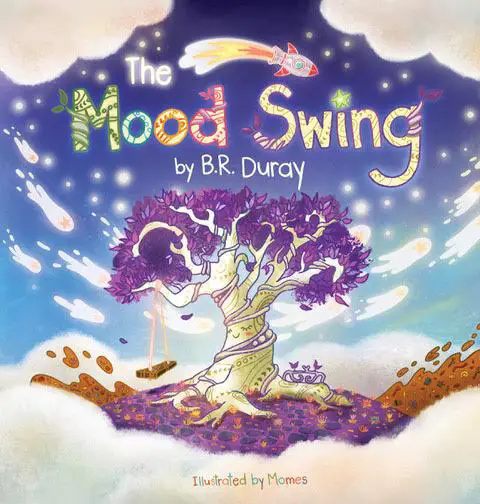
The Mood Swing is for the child in everybody who feels big ups and downs after the loss of a loved one. The story follows a young boy named Peter as he navigates the difficult emotions that surface after the loss of his father.
A magical swing, tethered to a Moon Tree, propels Peter into fantastical adventures that mirror his emotions. When Peter is happy, with both of his parents by his side, he blasts off into a beautiful trip through outer space. When he returns a year later without his father, the swing descends, plunging him into a pit of quicksand. But with the help of his mother, and the reminder that his father is never far, Peter learns to find his balance again and simply enjoy riding the swing.
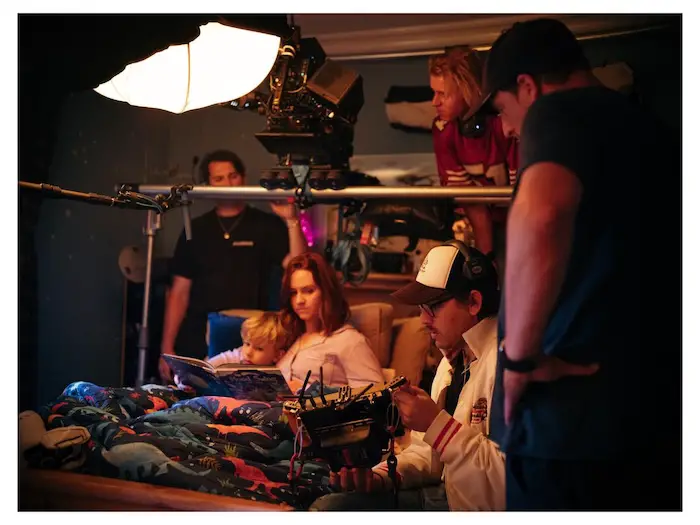
The short film follows a loving mother and her grieving five-year-old son as they’re guided by the storybook as it comes to life before bedtime.
I wrote this because stories were the way I made sense of big emotions when I was a kid. I lost my father when I was ten. At that age, you don’t have the vocabulary for grief. What you do have is imagination. You have the ability to project your emotional life onto the world around you.
I wanted to create something that helps kids understand that big feelings don’t make them “bad” or “broken.” They change and pass. And if you’re brave enough to sit with them, there’s always light on the other side.
So The Mood Swing is really a love letter to the kid I was back then, and to every child learning how to navigate the inner storms of growing up.
How do you hope this story will impact people–children and families in particular?
If anything, I hope it helps families talk. Not in a heavy way, just in a real way.
I want this story to be a tool for kids or families that need comfort. Something that says “having big feelings is human. It’s okay. It’ll pass. You’re not alone.”
If a parent and child can sit for five minutes and talk about real things because of this story, then The Mood Swing has done its job. That’s really the heart of it for me. If this story gives a family a moment of connection, or makes a kid feel understood, that’s everything. That’s the whole reason I made it.
And I wanted it to be fun and whimsical too. Even if there isn’t some major life disaster happening, it can still be a sweet little adventure before bedtime.
Where can we watch The Mood Swing (and buy the book)?
The short film is now available on YouTube:
And the picture book is available on Amazon.
Can you tell us about any projects you’re working on next?
Through my production company, Moon Tree Studios, we’ve started developing The Mood Swing into a children’s series that explores emotions through whimsical adventures. Kind of in the same lane as Curious George: simple, sweet, emotionally honest stories about growing up, brought to life through books and animated shorts.
Outside the children’s space, I have a new YouTube series launching January 13th called Anomaly. These are ten-minute episodes blending the tone of The Twilight Zone and The X-Files, all based on real UFO encounters people have actually reported. The first episode explores unidentified submerged objects and a rumored underwater base off the coast of Malibu.
It’s been cool to see how much this topic has entered the zeitgeist. I worked in the UFO world professionally for years, filming with government officials, pilots, researchers, and thought leaders during my time with To The Stars Academy and the History Channel’s Unidentified: Inside America’s UFO Investigation. Anomaly is my chance to take the real stories I’ve heard and give them the cinematic treatment they deserve.
Ultimately these projects are part of a bigger vision I’m building: creating worlds and universes- some for kids, some for adults- that all come from the same place of curiosity, wonder, trying to understand what it means to be human, and our place in the cosmos as we live through a major epoch change in society.