Lucía Aleñar Iglesias’s debut feature-length film, Forastera, explores grief and family dynamics in a distinctively nuanced manner. I chatted with the writer and director of the drama to explore the themes, its origins, and how the location plays an integral role in the story. The motion picture is generating buzz during its festival run, having won the Fipresci Prize at TIFF. So with the humor and grace evident in the movie, here’s what the filmmaker has to say about her process and decision-making during production.
Forastera started as a short film. Why was this the short of yours that demanded to be expanded upon?
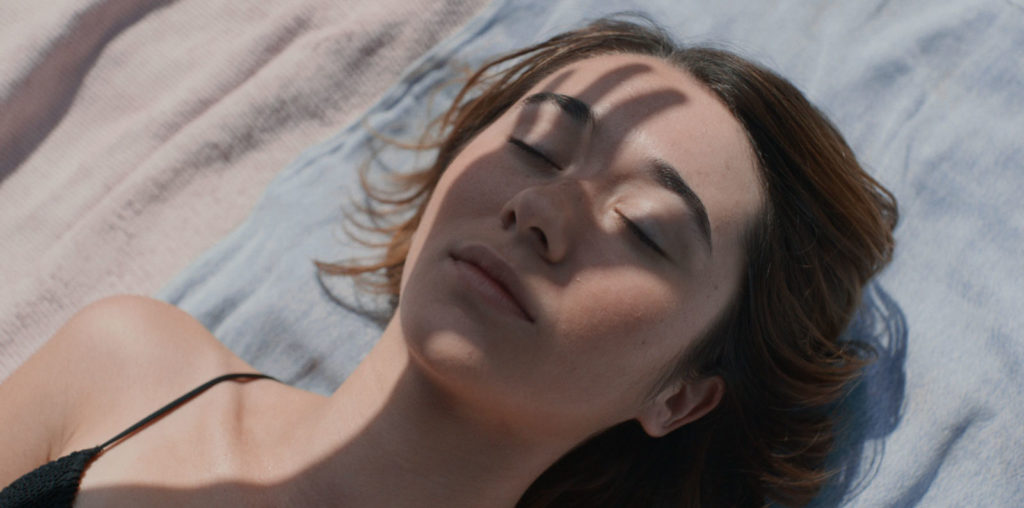
I knew there was more to this story than what the short film portrayed, but I also didn’t want to make the exact same film again. I wanted to delve deeper into Cata’s story, empower her more, and broaden the focus to include the rest of her family. The grandfather, for example, takes on a much more aware and emotionally engaged role. I also introduced Cata’s mother, whose presence creates a disruption. Visually, the short had a nostalgic, Mediterranean feel that we’ve preserved, though now the world of Forastera becomes a bubble — a more stylized Mallorca, perhaps, the Mallorca of a forastera.
Mallorca is a beautiful island for sure, but why use it as the setting for all that unfolds?
Well, I was interested in depicting grief in a beautiful place, one of breathtaking beauty. However, the title originates from the island; it directly translates to “foreigner,” but the locals use it to refer to Spaniards who visit or even end up living on the island. So the Mallorca in this film to me is the Mallorca of a forastera. As I mentioned, it’s almost like a bubble for Cata, which is a bit how I experienced summers there as a child. I wanted to emphasize the almost constant presence of the sea, the ways in which a forastera weaves through tourist traps and local customs of the island, or the presence of multiple languages. I couldn’t possibly represent all of the vibrancy Mallorca has to offer, but I wanted to create a version of this place that could allow a character like Cata to explore and transform in a way she would never allow herself to if she were home.

“We adopted a very collaborative approach to designing a visual language that felt, at times, postcard-like or painterly…”
Family dynamics are the main focal point of Forastera. There’s Cata’s pull to discover more about her deceased grandma. Then there’s the way Tomeu treats his granddaughter after she’s taken on more household duties. Cata’s mom seems to act more infantile when around her eldest child. How much of the relationships’ interplay is based on your childhood, and how much is based on wishing this is the way you could talk/interact with your family growing up?
Forastera isn’t autobiographical, but it does come from a feeling of strangeness around grief and how our behaviour changes when we’re processing grief, especially for the first time. I wanted to create a character like Cata who doesn’t quite know how to talk about what she’s feeling, so she finds a way to process grief by playing pretend, by disappearing into a projection. This transformation brings Cata closer to some family members and distances her from others. I was really interested in exploring how those family dynamics shift.
While family is a prominent theme, there’s also a pseudo-ghost element. There’s a mystery at play regarding what is truly causing Cata’s transformation. Without spoiling too much for anyone who hasn’t seen the film yet, how did you walk the line between family strife, supernatural happenings, and a teenage coming-of-age fable?
I wanted the ghostly elements to coexist in a more casual way in the world of Forastera. I wasn’t so much interested in the genre conventions we associate with ghosts, but really wanted these elements integrated into Cata’s emotional landscape. This ghostly presence affects Cata in the same way that her relationships with other characters would.
The cinematography throughout Forastera gives off a painterly yet haunting look; the photo sequence between Cata and grandpa is stunning and emotional. How did you and director of photography Agnès Piqué Corbera achieve the subtle beauty in the everyday?
Thank you, working with Agnès was so inspiring and rewarding. We adopted a very collaborative approach to designing a visual language that felt, at times, postcard-like or painterly, as you say, but that conveyed an eeriness that let us know we were just off-kilter. With very careful compositions and long takes, we wanted the viewer to wander through the scenes, lose track of time, and pay attention to the small details. We worked closely with our production designer, Gala Seguí, and costume designer, Pau Aulí, to create a color palette that enhanced the idea of reality mingling with something slightly artificial and slightly playful.