FT: In the first act, most of the female characters are talked over or sidelined. But in the second act, several of them get a voice of their own. Considering that, what message do you hope audiences all over the world will take away from seeing this film?
LB: It’s hard to generalise about such a thing, but in my context, I still notice too many men thinking that dialogue is just them talking and everyone else listening. Usually, it’s women and children, because it is very common in traditional families. But not exclusively. It also occurs in various professional spheres, where a common paternalistic approach to management prevails. I wanted to depict families as I see them. In the end, different viewers will take different messages about relationships from this film, and that is okay in my view. Thinking about the kind of relationships that get us through tough periods and what kind of relationships keep us stuck is important to me.
FT: Drowning Dry was made in and takes place in Lithuania. How much did the country inspire the story?
LB: I try to be as specific to the region as possible. It is not even about all of Lithuania. It is based on the characters and idiosyncrasies of my hometown, Kaunas. I find it easier to work when I am very much grounded in one place culturally and then try to conceptualise and structure the film around more abstract themes. The BMW under a semi is a very common sight.
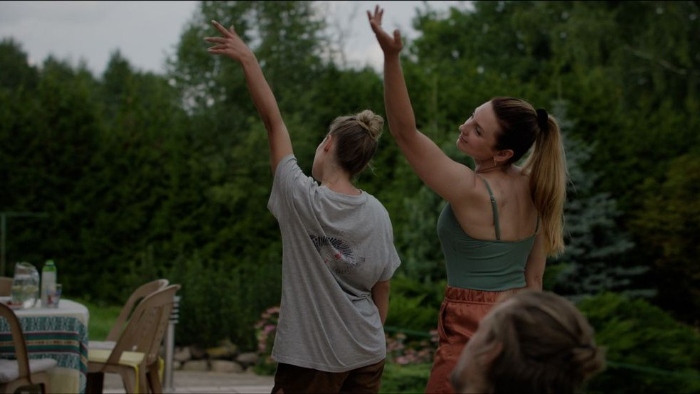
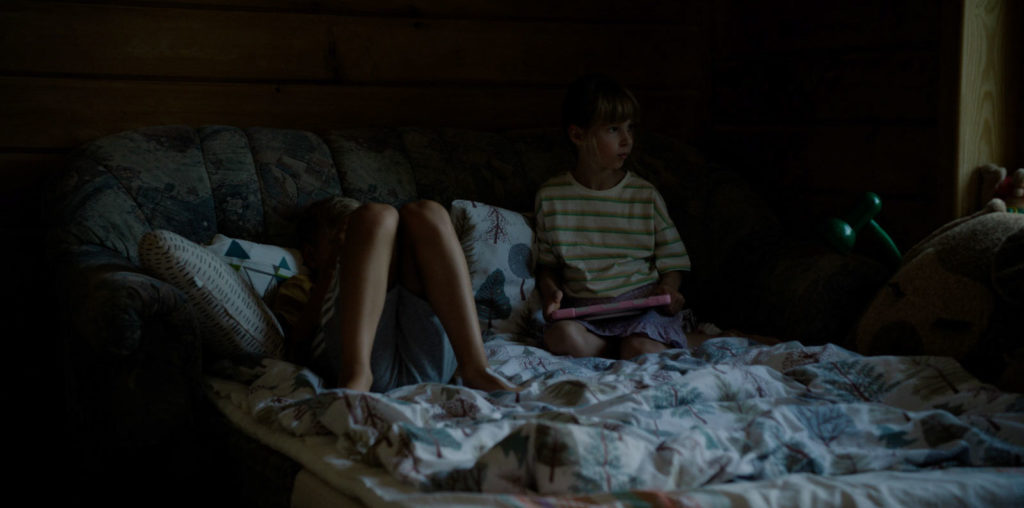
Screenshot from Drowning Dry.
“…I still notice too many men thinking that dialogue is just them talking and everyone else listening.”
FT: On a similar note, the cinematography is terrific, making for a beautiful travelogue of Lithuania. Were there any locations you wanted to shoot at but were unable?
LB: We had a hard time finding the summer house, because it is an uncommon arrangement in Lithuania. Most of our houses near the lakes look very rustic. I wanted a house to be more neutral, somewhere where the parents could have lived all year long. The car crash site was also a challenge, just because we had to close off part of the freeway. All in all, Lithuania is quite accommodating for film shoots. It even advertises as such for foreign producers, because most of our film industry is based on production services.
FT: The actors of Drowning Dry are quite incredible. They share a natural chemistry, making them feel like an actual family. What was the casting process like, and how long did it take to find the right person for each role?
LB: It took a year to finalise all of them. We started with the older sister, because we recognised her as the most difficult psychological portrait. Then we added the other characters one by one to keep track of their overall chemistry. The last adult was the fighter. I started off looking for a real fighter. It is uncommon in Lithuania to have physical transformations for actors because of time and budget issues. I had two professional fighters for the last casting round, where they rehearsed with the rest of the cast. But we couldn’t get the relationships going as hoped. Even though they acted naturally, they struggled to connect to other actors in the scene. They remained concentrated on themselves. Desperate, I contacted Paulius for the role as we had worked together a lot before, and I knew he could play this role if he beefed up significantly. I was hoping our past experience would sway him into committing to three months of daily exercises and extreme dieting. We added the kids last as we wanted them to match the parents.
FT: Finally, with the film now getting a theatrical release in North America, what would you like to say to any potential audience member to convince them to give Drowning Dry a fair shot?
LB: I imagine it’s a tough ask to invite someone in the middle of summer to go see a subtitled film. Honestly, if there are things that need working out, the film gives you a couple of hours to escape yourself through the stories of others. Then you can go back to the real world with the added perspectives of others on your situation, and maybe this helps a little.