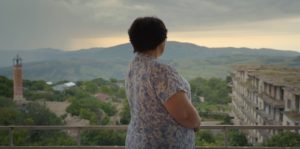
Storytelling, particularly fairy tales, is prevalent both before and after the war in the film. What do stories mean to Armenians, and is their history of storytelling enough to keep their culture alive in the current climate?
For Armenians, stories are a way of surviving. They’ve always carried our memory, our humor, our grief — everything that has helped us stay connected through generations of loss and displacement. The title of the film itself, There Was, There Was Not, comes from the opening line Armenian myths and stories — it’s our Once Upon A Time. It’s a phrase that holds both presence and absence, existence and erasure, in the same breath.
When the war began, I found myself questioning whether storytelling even mattered anymore. How could a story or a myth mean anything in the face of bombs and destruction? But as time went on, I realized that the act of telling — of naming, remembering, and imagining — was itself a form of resistance. Stories give shape to what might otherwise disappear.
Armenian folktales are not just whimsical; they’re often dark, cunning, and full of lessons about endurance and moral complexity. They remind us how to survive in an unjust world. So yes — I do believe that storytelling can help keep our culture alive. Maybe not by itself, but as part of a living practice: through language, through art, through the ways we choose to remember each other. Storytelling gives us a thread to hold onto, especially when everything else is being taken away.
How did you decide how much of the war to include versus exclude?
From the moment the war began, I was constantly filming, but when it came time to shape the story, I realized that showing everything wasn’t the same as helping people understand what it felt like to live through it. I didn’t want to make a film that led with spectacle or suffering — that’s the image of the Artsakh people have already been given for decades.
For me, it was crucial to hold onto the world that existed before the war. I wanted audiences to fall in love with these women and their daily lives first — to understand their humor, their contradictions, and their small rituals — so that when the war arrived, it would hold meaning. I wanted the loss to be felt, not just observed.
There was a lot of pressure, even during editing, to start the war earlier or make it more dramatic, but that felt wrong. I didn’t want to reproduce the logic of news coverage. I wanted to center the human experience — the slow unraveling, the silences, the grief that isn’t always visible.
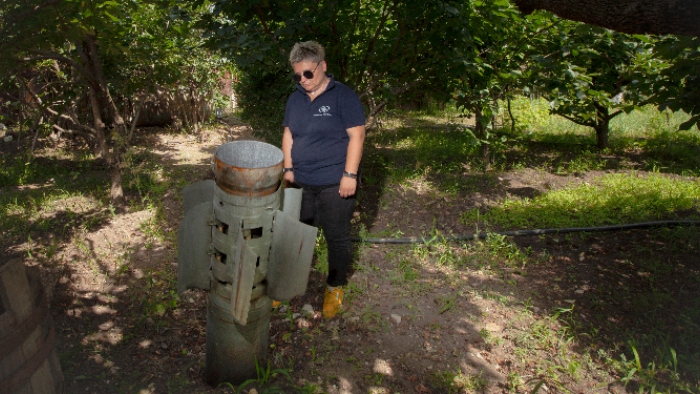
In the entire film, there’s only one shot of bombs. That was a very deliberate choice. I wanted the war to be felt through the women — through their faces, their voices, their displacement — rather than through explosions or spectacle. The film isn’t about the machinery of war; it’s about the human cost of it.
Working with my editor, Alexandria Bombach, was essential in shaping that restraint. We both believed that withholding imagery could create a more powerful emotional truth — that by honoring the quiet, we were actually making space for audiences to feel the enormity of what was lost. That collaboration helped the film stay grounded in intimacy rather than catastrophe, which felt truer to the lives of the women I had come to know so deeply.
Throughout There Was, There Was Not, you, via the camera, are a character. How well did you get to know the subjects, and are you still in contact with any of them?
I didn’t set out to be part of the story. In the beginning, I imagined making a more traditional vérité documentary — quiet, observational, where my presence would disappear. But over time, especially as the years went on and the war began, it became impossible to pretend that I was simply observing. The relationships I had with these women were real, built over years of shared meals, long drives, laughter, and grief. The boundaries between filmmaker and subject dissolved naturally, and what replaced them was care and accountability.
I filmed almost entirely on my own, so there was no crew between us — just me, the camera, and the space we created together. Over time, that camera became an extension of my body, a way of looking shaped by friendship and trust. When the war started, the women would call me, tell me what they were seeing, and ask for advice. I was part of their lives, not hovering outside of them. So I let the film reflect that. You can feel my presence — sometimes behind the camera, sometimes in the quiet exchanges or moments of recognition that pass between us. It felt more honest that way.
Showing myself, even just through the gaze of the camera, became an ethical decision. I didn’t want to reproduce the “neutral” gaze that so often defines how outsiders represent places like Artsakh. I wanted to acknowledge that I was implicated — emotionally, personally, politically — in what was happening. To care deeply is not a failure of objectivity; it’s a stance of responsibility.
I got to know each of them deeply — their humor, their fears, their contradictions. That trust was everything; it’s what allowed the film to exist. And yes, I’m still in touch with all of them. Our lives have changed since the war — some are in new countries, some are still rebuilding — but we continue to check in and support each other. The film may have ended, but the relationships did not.
“Maybe the future of Artsakh isn’t about reclaiming a territory but about preserving and evolving a culture…”
Politics obviously play a huge role in what happens throughout the film, even before the war begins. Do you foresee a future where Artsakh can come back and thrive, or are the political and racist machinations keeping it down too much to overcome?
This is a really difficult question — and one I still wrestle with. The truth is, right now, it’s hard to imagine a political path that leads to Artsakh as it once was. What’s happened there is not just the loss of land; it’s the destruction of a world — homes, language, memory, entire ways of life. And it happened while most of the world stayed silent.
But even if the political structure that allowed Artsakh to exist is gone, I don’t believe that means Artsakh itself is gone. Its people carry it with them. You can see it in the way displaced families rebuild small rituals in new places, in the way the songs, stories, and language continue to live in the diaspora. That endurance — that refusal to vanish — is what gives me hope.
I’ve stopped thinking about “return” in a purely geographic sense. Maybe the future of Artsakh isn’t about reclaiming a territory but about preserving and evolving a culture — keeping its stories, values, and sense of belonging alive wherever its people go. The women in my film embody that idea completely. They are not symbols of loss; they’re evidence that even amid erasure, life insists on continuing.
And still, every week, Sosé tells me, “We will return.” She says that my children and hers will one day see Artsakh again. I don’t know if that will happen in our lifetimes — but her faith reminds me that hope itself is a kind of home.
Finally, what advice do you have for any aspiring documentarians?
One important thing is to stay open to being changed by your film. When I started There Was, There Was Not, I thought I knew the story I was telling. Then the world shifted beneath my feet, and the documentary shifted with it. Let reality surprise you. Let your relationships shape the work. Some of the most profound moments happen when you surrender control and allow life to lead.
Also, build your films on trust. Everything depends on the relationships you make — with your subjects, your collaborators, your community. That trust isn’t just about access; it’s about responsibility. The camera carries weight, and how you use it matters. Ask yourself constantly: Why am I the one telling this story, and how can I do it with care?
I would also encourage filmmakers to look inward before they look outward — to really consider their own histories, identities, and lived experiences when choosing the stories they want to tell. The most powerful films often come from a place of personal connection or moral urgency — from something you carry inside you that refuses to be quiet.
And finally, remember that making documentaries isn’t just about capturing truth — it’s about creating space for others to be seen, and for history to be remembered differently. It’s slow, often uncomfortable work, but it’s also sacred. The act of witnessing — of refusing to look away — can itself be a form of love.