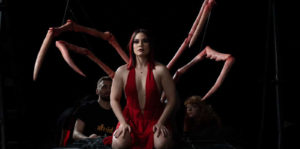
Known for his work with Juno Award-winning band Crown Lands, composer Kevin Comeau expanded his creative reach by scoring the surreal horror short Arachnid. The new film from director Luke Paron is a dread-soaked descent into obsession, psychological fracture, and something monstrous beneath the skin. Also starring pro wrestler Killer Kelly in her first film role, the film balances emotional weight with skin-crawling practical effects. I sat down with Kevin, Luke, and Kelly to discuss collaboration, back muscles, and why sometimes the best horror moments are filmed in a garage.
Kevin Comeau (Composer)
What inspired you to make your first solo release the score to a horror film?
I’ve been working on music my entire life. Crown Lands is the main project I’ve put music out through, but I’ve also collected a lot of solo recordings, some more acoustic and folk-inspired, and some synth-based. When Luke approached me about Arachnid and the influences he wanted to pull from, it was exactly in line with my tastes. It just felt like a beautiful convergence of timing and inspiration.
How did composing for Arachnid differ from creating music with Crown Lands?
It was totally different. When working with someone who isn’t a musician first, like Luke, their approach is completely fresh. The first pass I did for the film was very musically intensive, and I got more notes than I’ve ever received. That shifted the whole process. We ended up working together in the studio, composing live. That immediate feedback loop made a huge difference. It mirrored how John Carpenter and Alan Howarth would compose, just reacting live to the film. It ended up being a really creative and fast process, and one of my favourite pieces came from that, it’s the track that plays when Arachnid appears, and it was inspired by Ligeti’s Lux Aeterna from 2001: A Space Odyssey. We layered synth chords over and over to mimic that chorus sound.
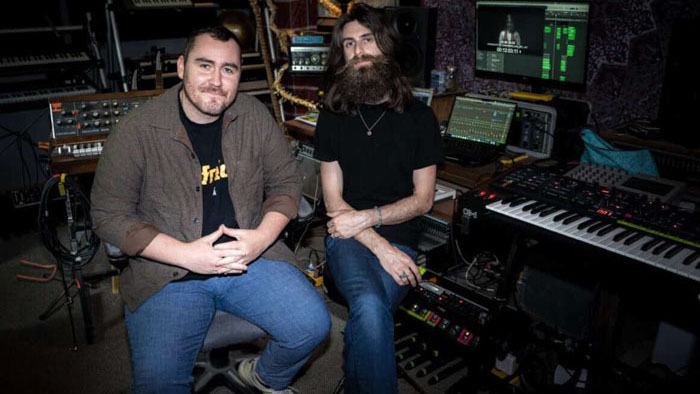
Composer Kevin Comeau and director Luke Paron in the studio during the making of Arachnid.
“We ended up creating sound design rather than traditional score by rubbing a mic against sweaters and beards and layering distortion.”
Were there any particular horror films or scores that influenced your sound for this?
Definitely John Carpenter. The Thing in particular. He’s the gold standard for analog synth horror. Luke had a huge influence here too. For him, it was about loneliness, the psychological aspect. He referenced Mica Levi, Mark Korven (The Lighthouse), Disasterpeace, and even Jeremy Soule’s Skyrim track “Silence Unbroken.” Translating those visual references into sound was a big part of the process.
What was it about this film that made you want to be involved?
Honestly, it was my relationship with Luke. He’s someone I really believe in, and it’s a great hang in the studio. That’s what matters in creative work, who you’re working with. But also, the themes of Arachnid, loneliness, and disconnection spoke to me. I thought it captured something very real.
How do you hope the score shapes the audience’s emotional experience?
Music guides emotion more than anything else. My first pass was totally wrong, emotionally, for what Luke wanted. It had too much dread where he wanted somberness, too much action where he wanted atmosphere. One of the most effective scenes was the therapy session. We ended up creating sound design rather than traditional score by rubbing a mic against sweaters and beards and layering distortion. It became something you feel more than hear, and in the theatre, it’s incredibly visceral. That was the goal. Create a physical unease that pulls the audience into the character’s psyche.
Luke Paron (Director)
What was the spark behind Arachnid? Where did the idea come from?
I tend to think in terms of scenes first. One night, I imagined someone descending from above me with spider arms, and that stuck. The story developed from that visual. At first, she descended on webs, but the budget changed that. Years passed before I revisited it, and when I met Killer Kelly, I knew I had to make it. I rewrote it from memory, which ended up being a blessing. It matured with me. The themes, like the so-called “male loneliness epidemic,” subtle incel culture, internalized misogyny, and a warped view of women and the world, became more relevant with time.
What made you approach Kevin to compose the score, and how did that collaboration take shape?
I’m a huge fan of Crown Lands. Kevin and I go way back, and when I started this film, I always hoped he could be part of it. At first, I didn’t give many notes because I respected him so much, but I quickly learned I needed to trust my own vision as a director. Once we worked together in the studio, everything clicked. That in-person workflow was incredible. Some great tracks didn’t make the final cut because of tone, but they’ll be on the album. It ended up being exactly what I wanted.
“It’s more about one man’s internal unraveling.”
The film has a psychological element alongside body horror. How did you approach balancing tone and pacing?
It’s hard to gauge pacing when you’re writing. The edit was where I refined everything. We cut a lot, even a scene with our biggest name, Matthew Rehwoldt, because it repeated themes. That tightened everything. The film is a character piece, and I knew if I loved it, someone else would too. You just have to trust your instincts.
What can horror fans expect from Arachnid that sets it apart?
It’s definitely not your typical horror short. No slashers, no haunted houses. It’s slow and introspective, and the horror elements come late and briefly. It’s more about one man’s internal unraveling. What I love most is how differently everyone interprets it. Some think it’s a delusion, some see it as a metaphor. That’s the best compliment to me.
Were there any standout challenges during production, either creatively or logistically?
Absolutely. The spider arm day was brutal. We had planned everything meticulously, but the timing didn’t work. We lost half the shots and had to improvise constantly. I ended up cleaning the gym (which we had converted into our stage for the night) myself and crying on the floor at 6 a.m., wondering how I’d finish the film. But the next day went beautifully, and in hindsight, it was for the best. A longer attack scene would have made the film too long. We were already close to the 15-minute cap, and shorter is better for festivals. Also, the bulging back effect? That wasn’t even shot on set. It was in my garage with a friend flexing under latex skin, filmed on a Sony A7III. You’d never know.
If you had to describe Arachnid in three words, what would they be?
An insomnia-fueled encounter. That surreal, hazy mood, like you haven’t slept in days, was the tone I wanted. The diner scene in Mulholland Drive was a big reference. That dreamlike uncertainty. That’s what Arachnid is to me.
Killer Kelly (Lead Performer)
You’re known for your intensity in the ring. What made you want to step into the world of horror?
It’s always been my dream, since I was probably a child, to be in a horror movie. I’ve always loved horror and everything about it. Being able to finally be in a horror movie, all because of Luke, because I told him that was my dream, it’s fantastic. It’s a dream come true. I loved being a part of it, and just being Arachnid, being that seductive character. I’m like that in real life too, seductive but kind of psycho. Total dream come true.
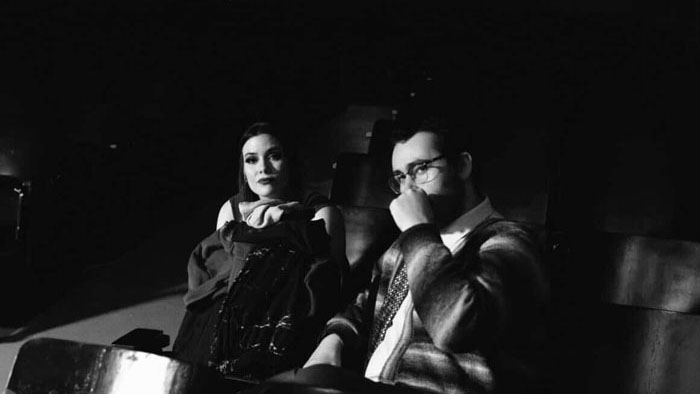
Director Luke Paron and actor Killer Kelly share a quiet theater moment in Arachnid.
“It’s always been my dream, since I was probably a child, to be in a horror movie.”
What was it about Arachnid that drew you in? The story, the vibe, the character, or something else?
Kelly: The whole vibe of it, everything, honestly. One thing I wasn’t expecting at first was that the character wouldn’t have any actual lines. At first, I thought, “Oh, that’s going to be kind of hard to pull off.” But guess what? It was easy.
Paron: I didn’t expect not to write lines for her either, but as it was coming together, I couldn’t justify it. Why would she talk to him? He sees her from the crowd and becomes obsessed. And I wanted to play into what Kelly already does so well. She tells stories with her face. Kelly’s got that iconic thing where she crawls into a space and just smiles, and I thought, let’s lean into that. I had written this years in advance, but once I knew I wanted to work with Kelly, I reworked it for her.
Kelly: Exactly, that’s what I wanted to say. It just worked without any dialogue. It was all about facial expressions, body movement, all of that. And it actually worked better that way. It made the character more unsettling, more powerful, without the need to explain anything. It was perfect.
How did it feel stepping into this lead role, especially in something so surreal and psychological?
Honestly, I felt really comfortable. It’s weird to say that, but I was totally in my element. I actually loved it. This whole experience made me want to do more projects like this.
Has this experience made you want to take on more film or horror roles in the future?
Absolutely. Give me all the horror roles! I love playing the creepy character, the bad guy. I wouldn’t mind being the victim either, but I feel like this kind of role fits me best.
What are you most proud of when it comes to your work on Arachnid?
That’s a hard one. I’m proud of everything, honestly. I’m proud of the entire movie and what Luke achieved. He was such a hands-on director, and he made everyone feel comfortable on set. I’m especially proud of how the final Arachnid scene turned out. It was surreal filming that late at night with the spider arms coming out of my back, everyone helping move them. It was such a team effort. Seeing the final result was incredible. It actually went above and beyond my expectations, and I already knew it was going to be good. But in the end? It was great.
Stay tuned for announcements regarding the home release of Arachnid and the accompanying soundtrack, both coming soon. In the meantime, the film continues its run on the festival circuit. Keep an eye out for upcoming screenings.