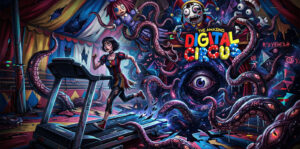
If you want to understand the mental state of the next generation, don’t look at their test scores. Look at a colorful, glitching jester named Pomni.
The series The Amazing Digital Circus (TADC) has become a certified indie phenomenon, racking up hundreds of millions of views on YouTube and selling merch throughout the West, in stores like Hot Topic and Target. But it isn’t the slapstick humor or the bright animation that’s hooking pre-teens and young adults. It’s that wide-eyed, vibrating realization that you are trapped in a world that doesn’t make sense, governed by rules that don’t matter, with no exit in sight.
For today’s youth, TADC isn’t a fantasy. It’s a mirror.
The Architecture of the Loop
We’ve seen this before. It’s Lewis Carroll’s Alice in Wonderland updated for the age of “Digital Dread.” But unlike Alice, who eventually wakes up, the modern version, seen in the show or the existential coldness of Harlan Ellison’s short story I Have No Mouth, and I Must Scream, and let’s not forget The Matrix, suggests the loop is the point.
Think about the world through the eyes of a 15-year-old today. They are on a treadmill they didn’t ask to join. They get up, go to a school system that feels like a factory of apathy, and listen to teachers who often seem more interested in deconstructing their history and culture than preparing them for a future, only to come home to parents who are doing the best they can in an upgraded version of that same system. They see a world outside of corporate media narratives and warring politicians who are actively trying to burn down anything stable, only to graduate into a gig economy that demands everything and pays for nothing.
It is a world of “liminal spaces,” hallways that lead to other hallways, “Exits” that turn out to be unfinished skyboxes, and a pervasive feeling that the “Admin” in charge doesn’t actually care if they’re suffering, and will even hurt you if you don’t play along with the narrative that everything is working just fine.
The Shared Frequency
I didn’t realize how deep this rabbit hole went until I started looking back at my own creative process.
A few years ago, I was deep in the production of my first feature, a Lovecraftian horror film called The Quantum Terror. I was deep into the idea of subterranean wash tunnels, liminal, concrete passages that run under the roads we drive on every day. I wanted to tell a story about a “trauma loop,” where every attempt to reach the light only deposited the characters back at the start of their nightmare.
I wasn’t trying to copy a trend; the “Digital Circus” didn’t exist yet. But as I watched Pomni struggle to find a door out of her colorful prison, I felt a jolt of recognition. I realized that the “monstrous-feminine” and the “phallic tentacles” I was putting on screen were manifestations of the same systemic frustrations. We are all independently dreaming of the same endless loop.
Whether it’s a digital tent or a concrete storm drain, the “Architecture of the Unthinkable” is the same. It’s the dread of being rendered rather than living. Again, The Matrix, John Carpenter’s “Apocalypse Trilogy,” Dark City, The Thirteenth Floor, and The Twilight Zone‘s “It’s a Good Life,” all show that this is not a new thing we feel.
Why They Watch
So why are kids obsessed with a show about being trapped? Because it validates their feeling of being lost in a world they are not equipped to comprehend and deal with.
When a character in TADC “abstracts” (losing their shape and becoming a chaotic mass of ink and eyes, which is very Lovecraftian) it represents the end-point of the treadmill. It’s what happens when you finally check out. But the show also offers a flicker of something else: the search.
By turning the “Loop” into a series of clues and secrets, these stories give the audience a way to fight back. They become “Narrative Archaeologists,” hunting for the glitch that proves the Bubble that is curated for them is a lie. Because if you can see past it, you might find the door to what is actually real.
When you stop to ask yourself why kids are so taken with a show about being trapped, you start to realize it’s because they are looking for a way to reconcile their dissatisfaction with the state of things, but more importantly, it gives them a space to find answers, which often feel like they are being deliberately withheld. In the Digital Circus, the drive to find the “Exit” becomes the ultimate act of rebellion. It whispers to every kid on the treadmill that the loop isn’t a life sentence but rather a puzzle that can be solved. If these fragmented, glitching characters can refuse to give up on the idea of a life outside the VR tent (in fact, the latest episode shows they can’t give up, even if they wanted to), it suggests that there is a world beyond the noise, a reality that is worth the fight to find.
In my own journey creating The Quantum Terror, I realized that we don’t go into the dark tunnels just to stay there. We go in to overcome what seeks to consume us and find the point where the nightmare fails. We tell these stories as maps, identifying the cracks where the real light shines through. By documenting the descent, we are actually charting the way through. Our goal is to tell stories that show how to get to the other side of the nonsense to something solid, meaningful, and real. My hope is that the final episode, which comes out this June, won’t betray the audience that has fallen in love with these characters by going for one of those twist “dark and edgy” endings, but find a way to affirm to them that there is a life outside the circus, and if we keep looking together, we’re going to find the door, and beyond it is a place we can build something for ourselves.
Christopher Moonlight is an animator, special effects artist, and the director of the ‘Award This’ winning movie, The Quantum Terror. His upcoming animated sci-fi adventure, Escape From Planet Omega-12, combines traditional film-making special effects with AI to create something never seen before in independent film. You can follow the behind-the-scenes, including tutorials, tips, and tricks, on his YouTube Channel, Substack, and christophermoonlight.productions website.