Having spent the first half of my career as a professional musician (clarinetist/conductor) and the latter half as a critic (music, films, and theatre), I can only look/hear this production as few others will.
The premise is as deceptively simple as a Mozart piano sonata: a complete set of Stradivarius instruments (2 violins, 1 viola, 1 cello), has been purchased by a semi-wealthy heiress (via her late, music-loving father) in order to perform a never-heard-before string quartet written by a friend-of-the-family composer and broadcast live from a remote church (near the family home by a hand-picked quartet). Who wouldn’t want to watch/listen to such an important musical event?
Natters first: leading the pack in the first chair is violinist George Massaro (gamely portrayed by Mathieu Spinosi), whose technique readily captivates even as his electrical skills, attempting to bring an outdoor hot tub to life, become a curious plot point. The grating script problem is when the virtuoso is frequently referred to as “concertmaster”—a designation reserved for first-chair. Having spent the first half of my career as a professional musician (clarinetist/conductor) and the latter half as a critic (music, films, and theatre), I can only look/hear this production as few others will.

“A complete set of Stradivarius instruments…purchased by a semi-wealthy heiress.”
The premise is as deceptively simple as a Mozart piano sonata: a complete set of Stradivarius instruments (2 violins, 1 viola, 1 cello), has been purchased by a semi-wealthy heiress (via her late, music-loving father) in order to perform a never-heard-before string quartet written by a friend-of-the-family composer and broadcast live from a remote church (near the family home by a hand-picked quartet). Who wouldn’t want to watch/listen to such an important musical event?
Natters first: leading the pack in the first chair is violinist George Massaro (gamely portrayed by Mathieu Spinosi), whose technique readily captivates even as his electrical skills, attempting to bring an outdoor hot tub to life, become a curious plot point. The grating script problem is when the virtuoso is frequently referred to as “concertmaster”—a designation reserved for first-chair orchestra violinists, not “Violin I” chamber musicians. Violin II, Peter Nicolescu, is blind and most caringly acted by Daniel Garlitsky, but—as many blind artists well know, they are perfectly capable of learning the “parts” (words, notes, songs…) par coeur, so then why is there music on his stand (or any stand at all)? Emma Ravier is the selfie-loving violist, Apolline Dessartre, adding much-needed vibrancy and joie de vivre to the troupe (yet being looked down upon by abandoning a string trio gig to take a seat with the Vienna Philharmonic—really? Name anyone who wouldn’t!). Leaving it to cellist Lise Carvalho (sympathetically portrayed by Marie Vialle) to anchor the sudden ensemble both musically and emotionally as various passions work their way into the score’s première.
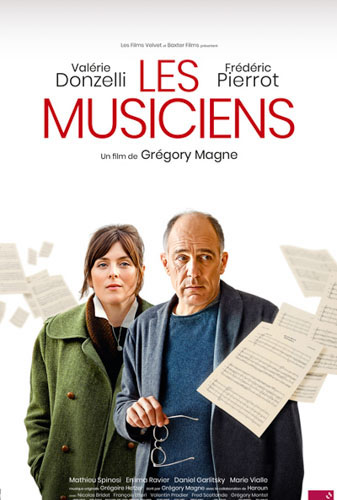
"…Just think about the starlings..."