A film that barely covered its production costs in theaters ended up rewriting how millions of people understood a card game. Rounders arrived in September 1998 with little fanfare, earning $22.9 million against a $12 million budget according to box office records. Critics gave it mixed reviews. Audiences stayed home. None of this mattered in the years that followed, when the movie became required viewing for anyone serious about sitting at a felt table.
The story follows Mike McDermott, a law student played by Matt Damon, who loses his entire bankroll to a Russian club owner named Teddy KGB in the opening minutes. The rest of the film tracks his return to underground poker rooms across New York City, pulled back into the life by his reckless friend Worm, played by Edward Norton. The plot itself is straightforward. What set Rounders apart was its treatment of the game as a legitimate pursuit rather than a vice for degenerates and criminals.
The Game That Mattered
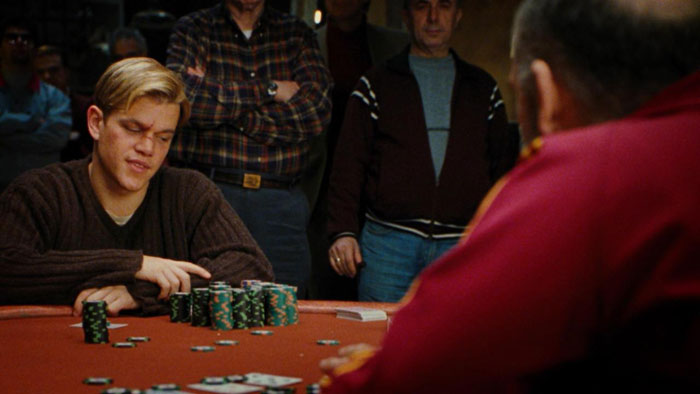
Rounders put one variant at the center of its story. The underground games run by Teddy KGB, the final confrontation between Mike McDermott and his nemesis, all of it played out across Texas Hold’em tables. This choice was not arbitrary. The game’s structure, with its community cards and betting rounds, gave screenwriters visible tension and dramatic stakes that stud or draw poker could not match on screen.
Chris Moneymaker confirmed that after seeing Rounders, he and his friends started playing almost exclusively no-limit hold ’em. His 2003 WSOP win followed five years later.
Language That Stuck
Before Rounders, poker terminology existed mainly within card rooms and home games. The film introduced phrases to a mass audience that had never heard them spoken aloud. Mike McDermott’s opening monologue explains pot odds and implied odds in plain terms. Later scenes reference reading tells, value betting, and slow playing with the assumption that viewers will follow along or learn through context.
This vocabulary entered common usage. People who had never played a hand of poker started throwing around terms like “nut straight” and “on tilt” because they heard Damon say them. The movie gave recreational players a shared language and made them feel like insiders rather than amateurs fumbling through casino cardrooms.
Professional Aspirations
Several players who later won millions at the World Series of Poker have pointed to Rounders as the reason they picked up cards in the first place. Brian Rast, Hevad Khan, Gavin Griffin, and Dutch Boyd all cited the film as an early influence. Vanessa Rousso put it plainly when she said that while plenty of movies have included poker, only Rounders really captures the energy and tension in the game.
The film presented professional poker as a career path rather than a form of gambling addiction or criminal activity. Mike McDermott treats it as a skill-based competition, studying opponents, managing bankrolls, and making calculated decisions under pressure. This framing gave cover to young players who wanted to pursue the game seriously without apologizing for it.
Television Borrowed From Film
Co-writer Brian Koppelman has stated that the hole card camera view used in televised poker was inspired by the film’s final poker scene. This matters because hole card cameras turned poker into watchable television. Before viewers could see what players were holding, broadcasts showed a series of bets and folds with no insight into the reasoning behind them.
The 2003 World Series of Poker, broadcast on ESPN, used hole card technology extensively. Audiences could finally understand why a player would push all-in with a weak hand or fold a strong one. Moneymaker’s victory that year, parlaying a $39 satellite entry into $2.5 million and the main event bracelet, played out with full visibility into his cards. The press called it the Moneymaker effect, and it brought thousands of new players into card rooms and online sites.
The Sequel Question
Matt Damon appeared on The Rich Eisen Show in August 2024 and confirmed that conversations about a second Rounders film have been ongoing for years. He mentioned that he had seen Edward Norton recently and that everyone involved wants to make it happen. Damon noted that so much has happened in that poker world in the last 25 years that catching up with the characters would make for an interesting story.
Whether a sequel materializes remains uncertain. The original film’s co-writers, Brian Koppelman and David Levien, have moved on to other projects including the television series Billions. Scheduling conflicts and financing concerns have delayed production multiple times over the past two decades. Still, the appetite exists among both fans and the creative team.
Underground Credibility
Rounders treated back-room poker games with respect rather than sensationalism. The Chesterfield Club, the games at Teddy KGB’s club, and the various spots Mike and Worm visit throughout New York City all feel lived-in and authentic. This came from research. Koppelman and Levien spent time in actual underground card rooms before writing the script.
The authenticity resonated with players who recognized the dynamics portrayed on screen. Petty cheats, stake arrangements between friends, the tension of owing money to dangerous people, all of it rang true. Players who had participated in similar games felt seen rather than mocked. The film treated their world as worthy of serious drama.
Bankroll as Character
Money functions differently in Rounders than in most films about gambling. Mike’s bankroll is not an abstraction. The audience knows exactly how much he has, how much he needs, and what he stands to lose at any given moment. When he drops $30,000 to Teddy KGB early in the film, the loss has weight because the movie has established what that money represents.
This granular attention to stakes taught audiences how professional players think about risk. Every decision at the table involves calculating potential gains against the cost of being wrong. Mike’s mental accounting throughout the film mirrors how serious players approach each session. You cannot play well if you cannot afford to lose.
The Legacy Holds
Twenty-six years after its release, Rounders remains the reference point for poker cinema. Later films have tried to capture the same energy. None succeeded to the same degree. The combination of authentic poker action, compelling characters, and cultural timing placed it at the center of a boom that reshaped card rooms around the world.