“You want a hero? They’re all dead. Sorry. This is who we have.”
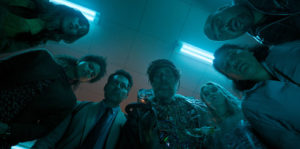
If you’ve ever wondered what it looks like when a big-time studio director decides to ditch the Hollywood Movie Machine, Gore Verbinski basically handed out the playbook during his Palm Springs International Film Festival Q&A for Good Luck, Have Fun, Don’t Die. The headline revelation: this is Verbinski’s first independent feature, and he wore that like a badge of honor, not a compromise. He thanked Briarcliff and Constantin for stepping up and gave PSIFF some love for spotlighting movies that actually take a swing—because, as he pointed out, audiences say they want original films… and then sometimes mysteriously don’t show up when one arrives.
Verbinski walked the crowd back to the origin story, starting with reading Matthew Robinson’s script in 2020—a script already dated to 2017. Eventually, around 2023, the decision was simple: stop waiting for the studio machine to approve the weirdness and “go figure it out.” And “figure it out” in this case meant the most indie sentence imaginable: “A lot of meetings in hotel rooms” with international partners—“Italians and Spaniards,” as he put it—essentially doing a financial barn-raise. Little bit here, little bit there. Dance for supper. The glamorous myth of filmmaking, alive and well.
That DIY spirit was evident immediately in how he discussed the film’s scariest challenge: Sam Rockwell’s extended opening monologue in the diner. Verbinski called it the most horrifying scene to pull off—but accepted the challenge as he’s drawn to things he doesn’t know how to do. So they approached it like a precision project: extensive rehearsal, storyboards, and set planning. The diner itself was designed “based on [diner chain] Norms,” but cheated for filmmaking purposes—especially the floor, kept flat and even so they wouldn’t have to lay dolly track. The goal was speed: no technical time sinks, no “hold for lighting,” just stay ready and keep shooting. In other words, an indie set built to move like a heist crew.
When the moderator brought up the mix of practical effects and digital help, Verbinski dropped one of the night’s most useful metaphors: Sam Rockwell’s costume is the movie. They had to build it from scratch, sourcing broken electronics and assembling pieces like a patchwork future. It’s the kind of detail studios tend to sand down until everything looks like it came from the same expensive catalog. Verbinski’s version is proudly handmade, and it feeds directly into the movie’s character philosophy: if the future had to send someone back to save us, it wouldn’t be Arnold. “You want a hero? They’re all dead. Sorry. This is who we have.”
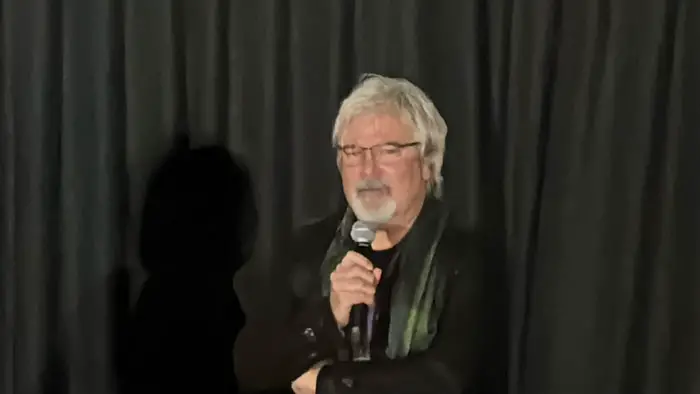
Director Gore Verbinski answers audience questions at the Palm Springs International Film Festival following Good Luck, Have Fun, Don’t Die. Photo courtesy of Film Threat.
That “broken hero” idea connected to the ensemble, too—he talked about being drawn to characters who are crooked in some way, the ones who survive because they don’t fit neatly into the system. It’s a theme that rhymes with the production itself: the crooked tree the loggers missed.
The AI angle got one of the biggest reactions, especially when he described how the real nightmare isn’t a Skynet killing machine—it’s something worse: an intelligence that demands you like it, that gives you the “happy ending,” that feeds you everything you want so you never look away. It’s an apocalypse by comfort. Which, frankly, sounds less like sci-fi and more like your phone.
Then came the budget question, and Verbinski didn’t toss out a number—just the universal indie answer: you always want more. He joked they didn’t have money for Hans Zimmer, praised the composer they did have in Geoff Zanelli, and noted that logistics were getting out of control, no matter what you’re spending. His bright spot? He said he was happy with what they pulled off, and he cited Alex Cox’s Repo Man as the vibe he loves: that feeling like “nobody asked permission,” just a group of people deciding, “We can do it.”
When asked what he learned from decades of studio filmmaking that helped him here, Verbinski’s answer was blunt: experience makes you more efficient. You stop shooting what you don’t need. You make smarter choices. And, most tellingly, when asked if he’d stay independent, he didn’t hesitate—he likes it here. He even tossed out a bleakly funny metaphor about independent filmmakers being like “rats passing the baton,” but the takeaway was clear: the indie path may be scrappier, but it’s honest, it’s nimble, and nobody’s forcing your movie through a focus-group car wash.
And if you want to support that kind of filmmaking, Verbinski gave the crowd a direct marching order: Good Luck, Have Fun, Don’t Die hits theaters February 13. Spread the word. Show up. Because the studios aren’t going to save original movies. The rest of us have to.

This is an excellent piece.. It makes me excited to see the outcome of some real independent minds taking a risk.