In 2012, I reached a breaking point. I was sick of the Hollywood “Permission Machine,” a system that demanded you audition for your own life while gatekeepers decided if your vision was “marketable” and if they’d let you retain your rights to it. I knew early on that I didn’t want a seat at their table; I wanted to be the head of my own. So, I packed up my family, risked everything, and moved to Texas. I didn’t have a studio backing me, just a refusal to play by the old rules and a drive to build something from the ground up.
Fast forward to 2026, where I have an award-winning movie under my belt, and that dream of total independence isn’t just possible, it’s engineerable. But it doesn’t start with a clapboard or a render; it starts with a conversation. Here is exactly how I used AI to turn a decade of ideas into a legitimate, profitable business engine.
1. Architecting the “Master Prompt.”
The biggest mistake filmmakers make is treating AI like a search engine. I treated mine like a Board of Directors. I started my business thread by uploading my entire creative history through Google Gemini’s NotebookLLM (a chatbot-driven dossier that you can tailor for whatever you want) and giving the AI a specific persona:
“You are a business planner and advisor, specializing in PR, financial planning, business organization, marketing, and merchandising. Our goal will be to turn my production company, Christopher Moonlight Productions, into a legitimate independent film studio… take me from working a full-time job… to working full-time at maximum profit for myself.”
By setting these constraints, identifying the “Thinking” model as our workspace, I turned the AI into a partner that understood the stakes were my actual livelihood. It didn’t just give me advice; it helped me map out a path to freedom.
2. The “Toyetic” Anchor
I am passionate about cinema, but I’ve also realized that in the new frontier, a movie cannot stand alone. To ensure I have the financial freedom to create exactly what I want, I told the AI we were building something “Toyetic.” Here was my prompt:
“These movies ideally will be highly toyetic (Suitable to be made into a marketable toy) with the idea of maximizing profits from toys, merchandise, video games, and other products, and ranging in genres.”
Whether it’s the hybrid-animated Escape From Planet Omega-12 or a practical creature puppet, the film is the beating heart of a larger ecosystem. The movie provides the emotional connection, while the merchandise (toys, collectibles, and physical media) provides the fuel. If you aren’t thinking about how your vision translates into physical artifacts, you’re missing the very things that allow you to stay independent.
3. Fourthwall: The Opportunity Gemini Found
One of the most valuable things Gemini did was introduce me to Fourthwall. Before this, I saw merchandising as a logistical nightmare. Having to think about warehousing, shipping, and storefront management is the death of a solo creator.
Gemini flagged Fourthwall as the solution: an all-in-one “creator-first” platform where I could host my website, handle the heavy lifting of fulfillment, and own my customer data. It’s a boutique storefront that integrates directly with YouTube and other social media. Without an AI looking at the “boring” logistics of my business plan, I likely would have completely missed this as a viable opportunity. Now, it’s most likely going to be the primary node for my publicity and physical distribution.
4. The Multi-Edit Distribution Strategy
We have all seen the “VOD Graveyard,” where great indie films go to die for pennies. My first movie, The Quantum Terror, currently resides in it, and while I’m grateful that people can watch my movie around the world, it’s not meeting its full potential. To combat this, I used AI to map out a tiered release strategy that makes every viewing a unique experience:
Theatrical: A “General Audience” cut designed for the big screen and indie multiplexes.
Physical Media: An “Unhinged” R-rated cut specifically for boutique Blu-ray collectors.
VOD: A separate, re-edited streaming version. By treating the edit as a fluid asset rather than a static file, you give your audience a reason to support the project across multiple platforms.
5. The “Pre-Digestion” Workflow
Being an “Independent Polymath” means balancing scripts, VFX renders, and business logistics. For those of us with ADHD or dyslexic tendencies, the mental load can lead to total “Choice Paralysis” along with burnout.
I used the AI to create a “Pre-Digestion” workflow. I tell it my current brain state, cluttered or overwhelmed, and it filters the noise into a Phase-Gate system. It breaks a broad goal (like “Set up a merch shelf”) into a four-step technical roadmap. This turns the chaos of running a studio into a series of executable daily tasks that reduce my signal-to-noise ratio and allow me to mark real-world accomplishments every day.
6. Defending the “Human Moat.”
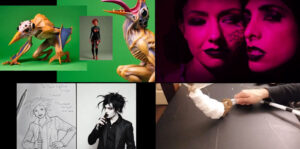
For Escape From Planet Omega-12, I’m blending generative AI video with physical miniatures and hand-crafted puppets. This hybrid approach is my “Human Moat.” The AI provides the scale and the propellant, but the practical effects provide the soul. When you layer digital power over physical “sweat,” you create a style that is nostalgic yet dangerously futuristic. It’s how you ensure your work never looks like “AI Slop.” You can weigh where AI is used against what you can hand-craft, based on your time and budget.
7. Owning the Means of Permission
The ultimate goal of this setup, the hardware and computing power, the AI architect, and the direct-to-fan distribution, is to remove the word “Please” from my vocabulary. You no longer have to ask a studio for a budget or a distributor for a slot.
By using AI as a structural engineer, you transition from a filmmaker seeking a deal to a Studio Principal. The “Permission Machine” is crumbling. If you have the courage to treat AI as an architect rather than a toy, to be a realist, a stoic, a serious adult, you won’t just survive the shift; you claim your territory in a new world.
The future belongs to those who can apply imagination to the gifts technology gives us.
Christopher Moonlight is an animator, special effects artist, and the director of the ‘Award This’ winning movie, The Quantum Terror. His upcoming animated sci-fi adventure, Escape From Planet Omega-12, combines traditional film-making special effects with AI to create something never seen before in independent film. You can follow the behind-the-scenes, including tutorials, tips, and tricks, on his YouTube Channel and Substack.