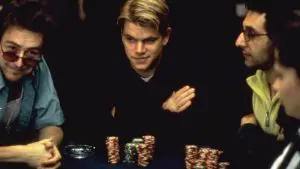
Hollywood has always had a complicated relationship with gambling. Some movies warn against its dangers, others romanticize the thrill of high-stakes action, while others make it look so easy to win that players must try it for themselves. But occasionally, a film comes along that does something remarkable—it actually changes how people play.
These five movies didn’t just entertain audiences. They measurably boosted the popularity of specific casino games, turning niche pastimes into cultural phenomena and reshaping the gambling landscape in ways their creators probably never imagined.
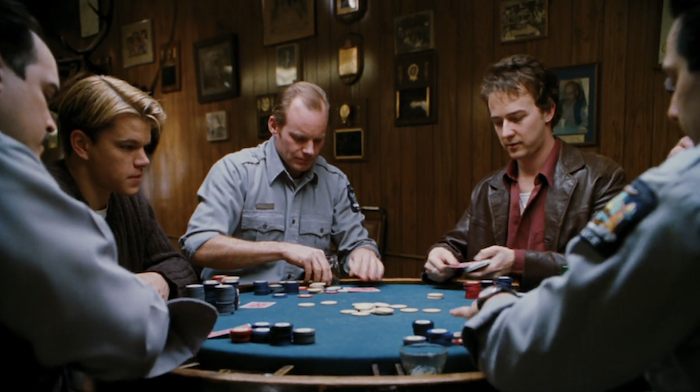
Rounders (1998): The Film That Made Texas Hold’em Cool
Before Rounders, poker was largely seen as an old man’s game played in smoky back rooms. The film changed all that by presenting Texas Hold’em as something strategic, psychological, and undeniably exciting.
Matt Damon’s Mike McDermott wasn’t just another gambling addict—he was a skilled player navigating a world where reading opponents mattered more than luck. The movie’s realistic portrayal of poker terminology, betting strategies, and the underground scene gave viewers an authentic glimpse into a world most had never seen.
The impact was extraordinary. Industry experts widely credit Rounders as one of the key catalysts for the poker boom that exploded in the early 2000s. The World Series of Poker Main Event saw participation skyrocket from 839 players in 2003 to over 8,700 by 2006. The 2000s were also the era of the online casino boom; the game saw an even larger boost thanks to the easier access to new online casinos available to everyone with internet access.
Professional players like Hevad Khan and Gavin Griffin have openly stated that Rounders inspired them to take poker seriously. The film didn’t just entertain—it created careers and transformed an entire industry.
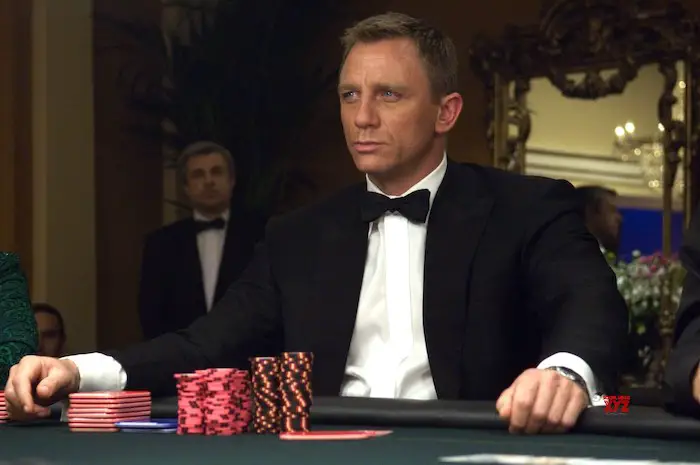
Casino Royale (2006): Bond’s Sophisticated Gamble
When Daniel Craig’s James Bond sat down at the poker table in Casino Royale, he wasn’t playing the standard game of baccarat traditionally associated with the character. Instead, director Martin Campbell chose No-Limit Texas Hold’em, riding the wave of poker’s mainstream popularity.
The film’s poker scenes were meticulously crafted. Real poker consultants ensured the gameplay was authentic, from chip handling to reading tells. This attention to detail made the high-stakes tournament feel genuinely thrilling rather than contrived.
Casino Royale arrived at the perfect moment to capitalize on poker’s cultural ascendance while simultaneously legitimizing it for audiences who might have dismissed it as lowbrow entertainment. Bond’s sophisticated approach to the game elevated poker’s image beyond the gritty underground world of Rounders.
While it’s difficult to isolate Casino Royale’s specific impact from the broader poker boom, the film undeniably helped sustain mainstream interest in Texas Hold’em during a crucial period of growth.
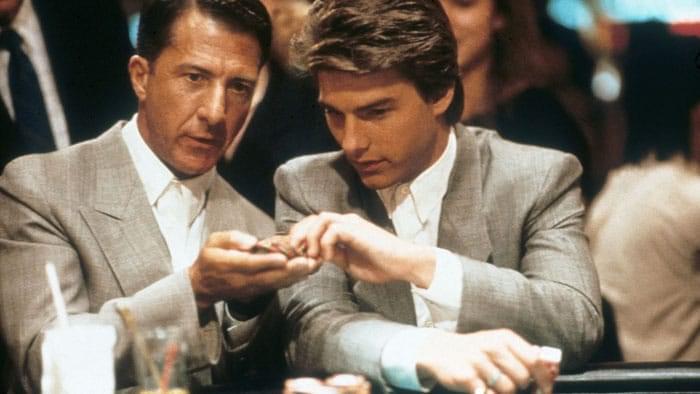
Rain Man (1988): The Card Counting Phenomenon
Rain Man introduced millions of moviegoers to a concept most had never heard of: card counting. Dustin Hoffman’s Raymond Babbitt, an autistic savant with an extraordinary memory, demonstrated how mathematical precision could beat the house at blackjack.
The film’s portrayal was both accurate and accessible, showing how card counting works without getting bogged down in complex explanations. Tom Cruise’s character served as the audience’s guide, learning alongside viewers as his brother’s abilities unfolded.
The real-world consequences were immediate and lasting. Public fascination with blackjack strategy surged, with card counting becoming part of popular culture vocabulary. More significantly, casinos responded by implementing new countermeasures.
Surveillance increased dramatically. Deck shuffling became more frequent, often between every round. Pit bosses received additional training to spot advantage players. The film essentially forced an entire industry to evolve its security practices, demonstrating just how seriously casinos took the threat of inspired amateur card counters.

21 (2008): MIT’s Mathematical Revolution
Two decades after Rain Man, 21 brought card counting back into the spotlight with a story that seemed almost too incredible to be true. The film dramatized the real MIT Blackjack Team’s adventures, showing how brilliant students used mathematics to win millions from Las Vegas casinos.
Unlike Rain Man’s supernatural approach to card counting, 21 presented it as a learnable skill. The movie demystified advantage play, showing the training, discipline, and teamwork required to succeed.
The film’s release coincided with increased internet access and online resources, making blackjack strategy more accessible than ever before. Search volume for terms like “card counting” and “blackjack strategy” spiked after the movie’s release.
Casinos reported more players attempting to use basic strategy and asking questions about card counting. While few moviegoers possessed the mathematical skills of MIT students, many were inspired to at least learn proper blackjack fundamentals.
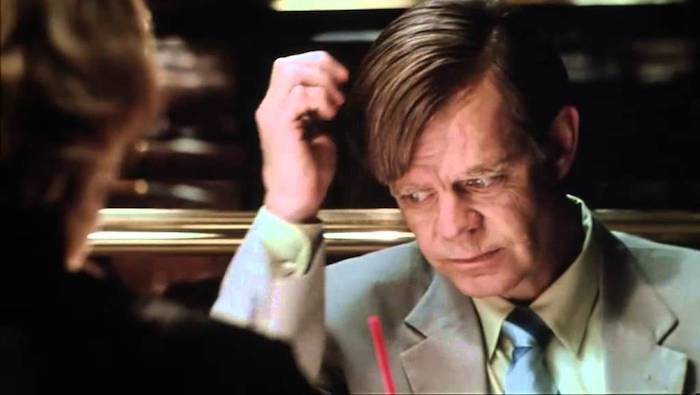
The Cooler (2003): Craps and Casino Mystique
The Cooler took a different approach to casino gaming, focusing on superstition rather than skill. William H. Macy’s character embodied every gambler’s worst fear—someone whose mere presence could kill a hot streak.
The film’s portrayal of craps captured the game’s unique social atmosphere. Unlike poker or blackjack, craps is inherently communal, with players cheering together when someone’s rolling hot and groaning collectively when luck turns cold.
While The Cooler didn’t generate the quantifiable impact of poker or blackjack movies, it contributed something equally valuable to craps culture. The film reinforced the game’s mythology, emphasizing the role of luck, streaks, and table energy that make craps uniquely appealing.
Casinos continue to market craps based on its social excitement and dramatic potential—themes that The Cooler helped crystallize in popular consciousness.
The Lasting Impact
These films didn’t just reflect existing gambling interests—they actively created new ones, turning millions of casual moviegoers into gamblers.
More importantly, they changed how we think about casino games. Poker became strategic rather than purely luck-based, thus more socially acceptable. Blackjack transformed from a simple guessing game into a battle of wits against the house. While neither is entirely true, but severely simplified to make Hollywood magic, it still sparked an interest beyond the normal.
This proves that sometimes, the most powerful marketing campaign isn’t an advertisement—it’s a great story, well told.