
Flordeliza Dayrit’s Time Hoppers: The Silk Road builds its adventure around kids jumping through history, using time travel to open a door into a Middle Eastern world shaped by discovery, scholarship, and cultural legacy. What begins as a futuristic sci-fi setup quickly turns into a race across the past, where young heroes are forced to protect knowledge and science before they are wiped out.
In the year 2050, 12-year-old Layla (Jayce McKenzie) is forced to leave home with her father, Habib (Omar Regan), after a home invasion by the shadowy Zoola, Inc. sends them into exile. They relocate to Vancouver’s Aqli Academy, a school for gifted children, where Layla reunites with her cousin Khalid (Tareek Talati) and quickly befriends Aysha (Angel Haven Rey) and Abdullah (Emily Gin). Soon, the four kids are brought into a secret project run by Dean Hafsa (Aliyah Harris), who is developing a time machine. He insists they document his time-traveling adventures from the present, but they are sent back in time by mistake.
Their first stop is 825 Baghdad and the House of Wisdom, where the children find themselves in the middle of a scientific golden age. Being scientifically minded themselves, they soon run into Fasid (Morris Seng), an embittered alchemist who has just been cast out and is desperate for revenge against the scientific community. When Fasid gains control of time travel, he sets out to erase the work of the great thinkers whose discoveries will shape the future. That turns the four kids into the Time Hoppers: The Silk Road, forcing them to chase Fasid across the Silk Road and protect the scientists and inventors whose ideas will one day lead to modern technology. All the while, they must avoid getting stuck in time themselves.
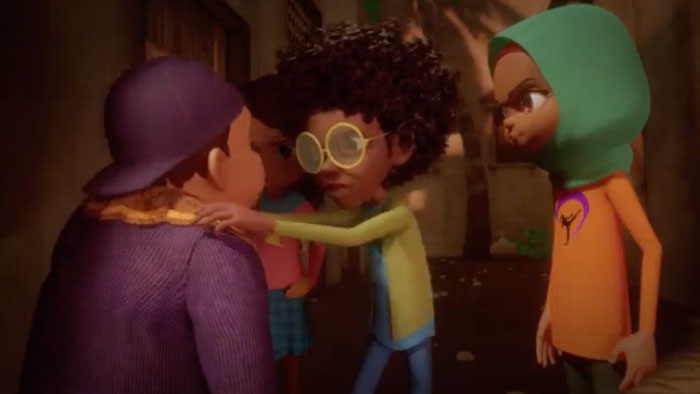
“…a race across the past, where young heroes are forced to protect knowledge and science before they are wiped out.”
As a lifelong Westerner, I found Time Hoppers: The Silk Road to be a children’s story set in an Islamic context. Co-director Flordeliza Dayrit made the film so kids with Islamic backgrounds could “see themselves as heroes” and see their culture and history celebrated to dispel or diffuse present-day Islamophobia. Her goal was to make the history of her culture fun for kids to learn and embrace. The historical settings are broad, spanning not just the Middle East but also Asia and Africa. It also brings the kids to moments where “magic” and science collide in history.
Regarding the animation, it’s not a Disney movie, but it rivals the work of many young animation studios here in the West. Much of the CG animation focuses on the setting, from walks down ancient streets to the characters’ authentic human movements. Again, not Disney, but good enough.
I think the character development of the main cast could have been pushed a bit further. The film needs to make its four heroes more distinct in personality and give each a unique perspective on history and science. Much of the film centers on friendship and loyalty—leave no friend behind. I think the pieces are there to really hit home with the conflicts Muslim children face in everyday life. Those conflicts could help them grow into adults by challenging their personal weaknesses.
Time Hoppers: The Silk Road is a good start for a series of stories about a time and culture I know very little about. What excites me about the next story is the evolution of both the animation and its storytelling. The bottom line is that it’s a fine story for parents and children of Middle Eastern and Muslim backgrounds to find themselves immersed in a new story that feels very familiar.
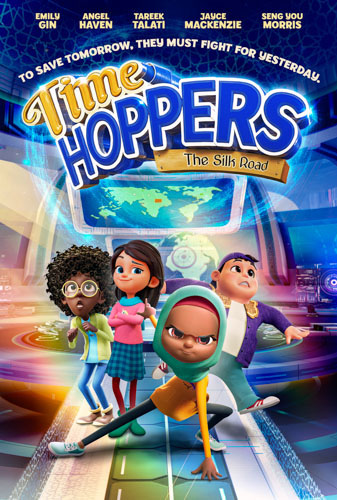
"…a good start for a series of stories about a time and culture I know very little about."