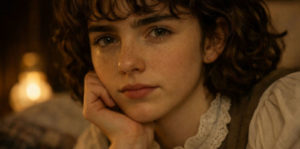
For avid Film Threat readers, one name that comes up regularly on our site is AI filmmaker Hooroo Jackson. It all began with his first fully AI feature, Window Seat; later came his pick-your-own 2D- or 3D-animated feature, A Very Long Carriage Ride; and then his first photoreal AI romantic feature, Strings.
In the Antebellum South, the Beaufort sisters live within the rigid rules of plantation society, where class, manners, and family standing shape every part of their lives. The youngest, Nellie Beaufort, is different. She escapes into her imagination, creating puppet plays that the people around her dismiss as childish nonsense. But Nellie is serious about her little productions, and her fascination with puppetry deepens when she becomes aware of the talented performers moving through her world, especially Mr. Bellamy and his gifted partner, Daniel Brock.
Daniel Brock is a Black puppeteer whose skill and quiet confidence immediately capture Nellie’s attention. What begins as curiosity about his craft soon turns into something more personal as the two spend time together through Bellamy’s circle and the work of building performances. Their shared love of storytelling draws them close, and before long, that artistic connection becomes a secret romance. Through rehearsals, conversations, and the care they put into each puppet and performance, Nellie finds in Daniel someone who understands her in a way no one else does.
With Hooroo Jackson, you can see a body of work that charts the evolution of a filmmaker working with off-the-shelf AI tools. Sure, the big studios have their own proprietary artificial intelligence, backed by millions in research and development, but for us normies, we’re spending hundreds, if not thousands, on subscription plans and whatever else it takes. For Jackson, storytelling is only part of the mission; he is also focused on clearing specific technical hurdles with AI.
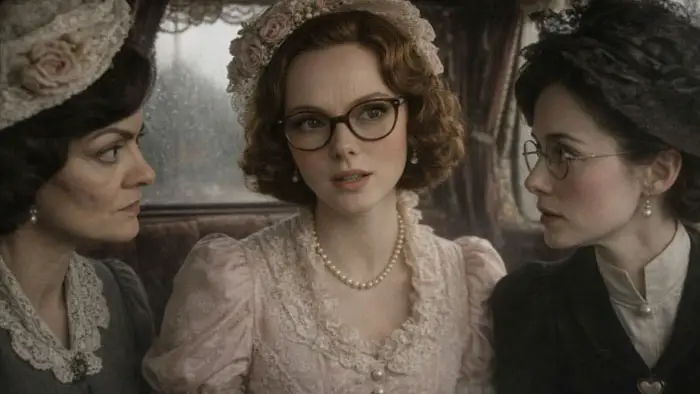
“Daniel Brock is a Black puppeteer whose skill and quiet confidence immediately capture Nellie’s attention.”
Here, Jackson sets his sights on a photorealistic feature in which everyone and everything looks human, and nature looks real. More importantly, he has found a way to maintain character design integrity from start to finish, so the characters look the same at the beginning and end of the film. In Strings, it’s not perfect, but it is good enough. Mission accomplished.
As fascinating as this AI journey is, and as much as Jackson is ushering me through it, we’re not there yet. Still, I find myself wondering whether the problems I’m about to raise can be fixed. The first is the story itself. My assumption is that AI is writing it. In Strings, the romance and overall narrative feel uncontrolled, as if we are letting AI spew out the story while we, as human observers, sit there wondering what kind of mess this is. The story lacks focus, and the dialogue feels like it was written by a computer. It does not take into account how audiences hear and process lines for comprehension. I got lost in the story a lot, and when you lose your audience, you lose them. The script is also too long and too crowded with characters. Jackson has got to find a way to make the story more efficient.
The second issue is the no-brakes nature of the dialogue. I mentioned this in the last film, My Boyfriend Is a Superhero? It is as if I am listening to a computer read a script with no pauses, all at the same pace and tempo, with very little emotion coming through. There has to be a way to add pauses and more deliberate, emotive expression to the dialogue, especially when it wants to be poetic. We need to savor poetry… hell, we need to savor dialogue.
What Jackson achieves visually with Strings is undeniably ambitious, especially in pushing photoreal AI characters toward greater consistency and a more believable physical space. But a movie still lives or dies on story and performance, and here, the film proves that crossing a technical threshold is not the same as crossing the finish line.
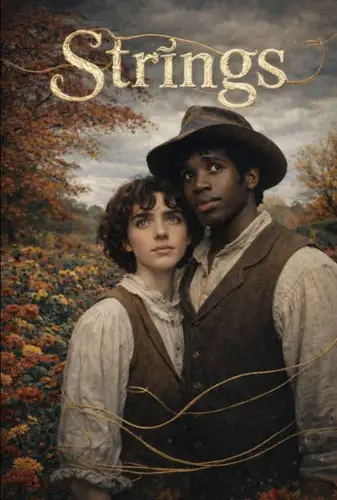
"…undeniably ambitious..."