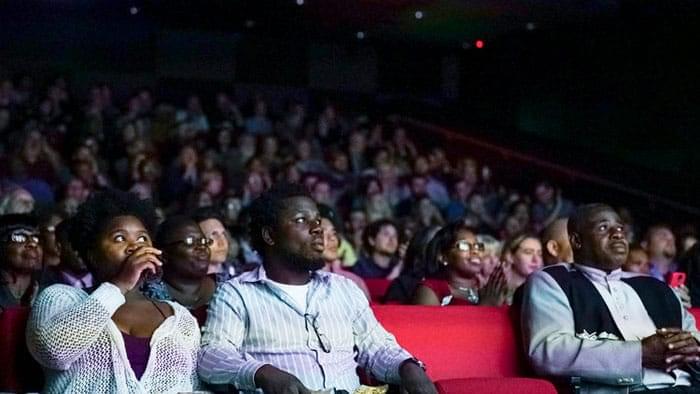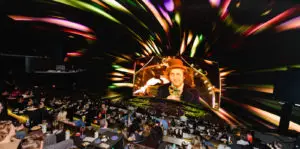
Movie theaters have spent the better part of the last decade chasing “premium” upgrades—bigger screens, louder sound systems, reclining seats—while audiences continued drifting toward their living rooms. Cosm takes a far more aggressive swing at the problem. The simplest way to describe its Shared Reality format is ScreenX on steroids: an immersive theatrical experience that surrounds the audience by more than 180 degrees, enveloping viewers inside an 87-foot-diameter, 12K+ LED dome that collapses the distance between spectator and screen.
That approach was on full display with the Shared Reality premiere of Willy Wonka and the Chocolate Factory and its first cinematic experience with The Matrix, where the films became less passive viewing experiences and more events. Iconic sequences unfold across the curved dome and into peripheral vision, pulling the audience into Wonka’s world without altering the film itself. Rather than remixing or rewriting a classic, Cosm builds an environment around it—one designed to heighten scale, emotion, and communal reaction.
To explore how this premium theatrical model works—and why it may signal a meaningful shift in exhibition—this interview brings together the creative and business minds behind Cosm’s Shared Reality productions: Alexis Scalice, Vice President of Business Development for Entertainment at Cosm; Jay Rinsky, Founder and Chief Creative Officer of Little Cinema; and Kirk Shintani, Creative Director at MakeMake. Together, they are redefining what theatrical presentation can be, positioning cinema not as background entertainment but as an experience that surrounds, engages, and reconnects audiences in ways traditional screens simply cannot.
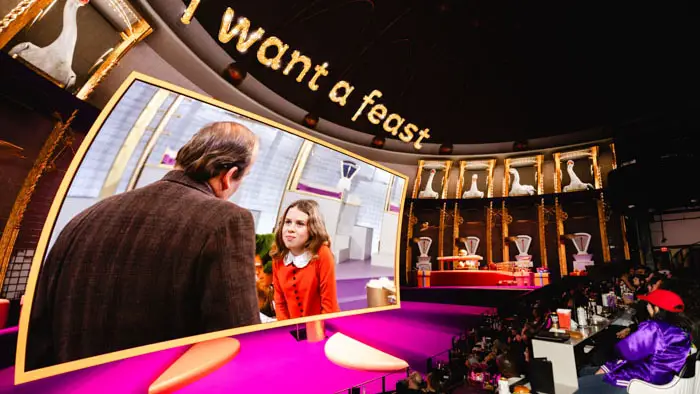
Veruca Salt demands a goose that lays golden eggs during Willy Wonka and the Chocolate Factory, expanded across Cosm’s Shared Reality dome.
“Rather than remixing or rewriting a classic, Cosm builds an environment around it—one designed to heighten scale, emotion, and communal reaction.”
Cosm began not as a movie theater company, but as an experiential technology platform designed to immerse audiences in live events, particularly sports. That DNA—large-scale LED domes, shared environments, and a focus on collective fandom—shaped the company’s expansion into the entertainment industry. Rather than retrofitting existing theaters for cinema, Cosm built its venues from the ground up to support what it calls “Shared Reality,” a format designed to make audiences feel present within the content. With locations launched in Los Angeles and Dallas, and expansion planned for Atlanta and Detroit in 2026 and Cleveland in 2027, Cosm positions itself as a new exhibition platform rather than a variation on the traditional multiplex.
Cosm’s move into movies was a natural extension of a platform already built around sports and live entertainment. As Alexis Scalice explains, athletics may be the anchor, but the underlying mission is broader: “The foundation of everything we do at Cosm is fandom and the consumer experience.” After redefining how audiences watch live sports, the company began seeing the same emotional and communal potential in cinema. “We just saw the same type of cross-pollination on how fandom and people absolutely love movies and cinema,” Scalice says, noting that Cosm isn’t chasing novelty so much as reviving the shared emotional response that once defined theatrical moviegoing. The goal is not to replace traditional exhibition, but to create a parallel experience in which films feel communal again rather than disposable.
Once the audience sits down and the movie begins, Willy Wonka and the Chocolate Factory unfolds inside Cosm’s Shared Reality dome. The film remains intact, but the story’s environment expands around it, designed to “transport people” and feel “like virtual reality, but without a headset.” As the story moves into the factory, key moments such as the Chocolate Room and tunnel are enhanced through scale, motion, and depth, creating what Creative Director Kirk Shintani describes as an experience where “you do feel like you’re on a ride moving through that space,” allowing the audience to feel entirely inside Wonka’s world while still watching the original film as it was meant to be seen.