OK. This one’s a hard sell. Co-writers and co-directors Samuel Felinton and Declan Mungovan’s experimental film, The Freedom of Uselessness, challenges the traditional narrative. In fact, it fights against any form of forward momentum. It simply exists.
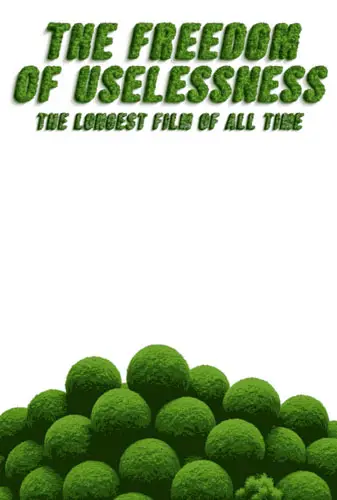
The scene is basically a desk, maybe from a college dorm, but context doesn’t matter. On that desk is a small glass jar set up as an aquarium, containing two moss balls, a rock with googly eyes, and a digital clock set to 6:53. Behind the clock is a figurine of a fisherman made of welded metal pieces. The only movement on the screen is the time changing every minute. That’s all you see for 30 minutes, and remember this is only 30 minutes of a 100-day YouTube livestream, which I assume consists of the same image throughout.
“…a small glass jar set up as an aquarium, containing two moss balls, a rock with googly eyes, and a digital clock set to 6:53.”
I won’t even pretend to tell you what this film is from my perspective; instead, I’ll tell you what it is from the filmmakers’ perspective and the explanation they gave me. The Freedom of Uselessness is deeply rooted in Taoist philosophy, particularly in the principle of wu wei—effortless action, non-striving, and harmony with the natural flow of life. Co-directors Samuel Felinton and Declan Mungovan construct the film as a lived experiment, following two figures, Spoiled and Bubba (I assume these are the moss balls), who deliberately abandon productivity, ambition, and measurable purpose. Their extreme uselessness becomes a quiet form of resistance against a culture obsessed with output and optimization. By simply existing over a continuous, record-breaking 100-day span, the film asks what freedom looks like when individuals step outside systems that demand constant labor, attention, and self-exploitation. This question feels especially relevant amid modern burnout and surveillance culture.
Rather than following a traditional narrative arc, the film intentionally subverts conventional storytelling by making time itself the subject. There are no plot beats, story arcs, or resolution—only duration, repetition, and endurance. This places the film firmly within the tradition of experimental cinema, where meaning emerges through sustained observation rather than dramatic incident. Cinema does not require spectacle, actors, or even a story to exist. By rejecting narrative momentum, the film challenges viewers to reconsider what qualifies as cinema and whether simply watching time unfold can be a radical act in itself.
Every time I want to be critical of The Freedom of Uselessness, I fall right into its trap. I’m an impatient person who constantly has to work. The idea of simply existing is an anathema, but maybe I’m the one who needs this film the most. I’m wrestling with myself right now. Ultimately, to find any enjoyment in the work of Felinton and Mungovan requires you to buy into the process. You may not be able to watch the full 100 days now, but maybe in the near future, that time will come. In the meantime, I’ve got a million things to do.
For more information, visit the The Freedom of Uselessness official website,
"…a hard sell."