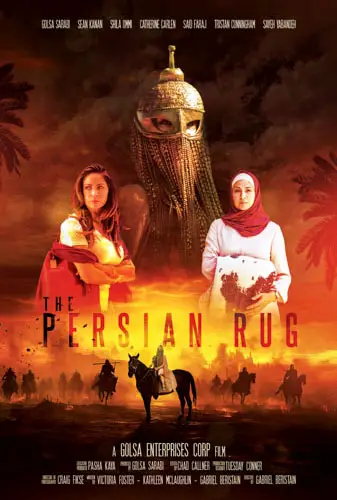
Gabriel Beristain’s dramatic short, The Persian Rug, begins in modern-day Los Angeles, where Golsa (Golsa Sarabi), a former Miss Iran turned aspiring actress, prepares for a career-defining audition. The role is for Fatima, a veiled Iranian woman torn between tradition and rebellion, in a controversial Western film. The director, Gerard Duvall (Sean Kanan), and casting director, Niki (Tristan Cunningham), both see potential in Golsa’s emotional depth and schedule her for several callbacks.
After the audition, Golsa visits a nearby mosque to pray. There, Golsa sees a vision of Zara, a ghostly version of herself, representing the women left behind in Iran. Zara embodies their pain, strength, and the price of defiance under a repressive system. Golsa finds herself defending the choices she made in America. The arguments center around Zara’s hijab. Golsa sees it as an object of repression, but Zara sees it as a symbol of resistance.
“Golsa sees a vision of Zara, a ghostly version of herself, representing the women left behind in Iran.”
Returning home to her mother, Akram (Shila Ommi), Golsa senses her mother’s disappointment in her for abandoning her degree and pursuing what she believes is a shallow dream of acting and modeling. As news reports play in the background about women in Iran being punished for defying the veil, mother and daughter clash over what it truly means to be a Persian woman.
Co-writer/director Beristain sees The Persian Rug as a soliloquy. Though not performed on stage, the story is about Golsa coming to grips with what it means to be a Persian woman today as she is caught between her new life in the West and her heritage and culture, which do not exactly hold women in the highest esteem, at least not today.
It’s a soliloquy in the sense that conversations Golsa has with her mother, Akram, friend Niki, and her alter ego, Zara, are not casual chit-chat but speak directly to the issue at hand. Through Golsa Sarabi’s performance, we witness the transformation Golsa undergoes, reconciling the trauma, resilience, and truth of the women she represents.
The Persian Rug closes on a note of quiet reflection, as Golsa finally understands that identity is not about choosing between two worlds but learning to carry both.
"…a haunting dialogue between freedom and faith."