The air is thick with a now all too familiar lament. Walk through any online forum, attend an industry panel, or simply listen to casual conversation, and you’ll hear it: AI, they say, is killing creativity. It’s making art bland, artists lazy, and culture stagnant. This isn’t just a concern; it’s an accusation, often delivered with an air of certainty, as if the very idea is self-evident. But what if this widespread condemnation isn’t a sign of AI’s destructive power, but rather a profound failure of imagination on the part of its critics? What if blaming AI for a supposed lack of creativity is, in itself, the ultimate act of shortsightedness?
Let’s dispense with one of the most common, and frankly, baffling, arguments right from the start: “AI can’t be creative.” This statement is often dropped like a mic into conversations, as if it delivers a knockout blow. Yet, it’s a red herring, diverting attention from the actual discussion. Of course, AI can’t be creative. A paintbrush can’t be creative. A keyboard can’t be creative. A printing press can’t be creative. These are tools. They possess no consciousness, no intention, no soul. Creativity has always resided in the human mind that wields the tool, and it will continue to do so. The point was never that AI would become a sentient artist; the point is what humans can be creative with it. To dismiss an entire frontier of artistic exploration because the tool itself lacks sentience is to fundamentally misunderstand the nature of art-making.
“Of course, AI can’t be creative. A paintbrush can’t be creative.”
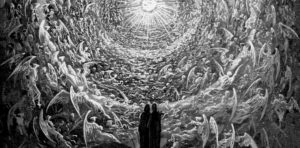
Throughout history, humanity’s relationship with its creative tools has been a dynamic interplay of discipline, adaptation, and revolutionary discovery. Consider the colossal talent of the artist Gustave Doré, whose breathtaking illustrations continue to define our visual understanding of the Bible, as well as literary epics like Dante’s Inferno to Milton’s Paradise Lost. Doré’s genius was not expressed on a blank canvas with a free hand, but was rigorously disciplined and profoundly shaped by the demanding medium of wood engraving.
Engraving, unlike drawing or painting, is a relief printing technique in which the artist (or their skilled engravers, often working closely with Doré’s designs) cuts away the parts of the woodblock that are not intended to print. What remains is raised forms the image. This highly precise method, typically performed on the end-grain of hardwood like boxwood, demanded an entirely different way of thinking about form, light, and texture. Doré could not simply draw a shadow; he had to build it from thousands of meticulously placed lines, cross-hatching, and dots, creating a tonal spectrum from pure black to luminous white. The constraints of a black-and-white medium forced him to master dramatic chiaroscuro, the interplay of light and shadow, making it a signature of his work. His sprawling, detailed compositions, filled with intricate figures and atmospheric landscapes, were conceived with the specific mechanical capabilities of the printing press in mind.
Doré didn’t merely adapt to the printing press; he pushed its boundaries, effectively helping to revolutionize illustrative art and, in turn, making classic literature accessible to a vast new audience. His talent and imagination were not stifled but molded by these parameters, leading to a distinctive visual language that remains powerful to this day. He found freedom within the form, demonstrating how the very limitations of a medium can be the wellspring of innovation.
"…the real conversation isn't whether AI can be creative, but what new, unprecedented forms of human creativity it will enable."