Writer-director Seabold Krebs’s Bury Me When I’m Dead, his debut, is a psychological horror film that deliberately distances itself from the jump-scare tactics dominating mainstream North American horror. Instead, it leans into moody atmospherics, blending imagery with a musical score to craft a story of guilt and retribution. From the outset, the film establishes that it’s more concerned with psychology, the role of silence, and facial expressions than with visceral shocks.
The film follows Henry (Devon Terrell), a man whose failure to fulfill his dying wife’s last wish plunges him into a nightmare. Catherine (Charlotte Hope), the terminally ill wife, gets him to promise to bury her in a secluded forest near her childhood home. However, Henry, already burdened by the secret affair with their friend and coworker Rebecca (Makenzie Leigh), who is carrying his child, reneges on his vow under pressure from Catherine’s domineering father, Gary (Richard Bekins). This failure sets in motion a series of occurrences that blur the line between Henry’s unravelling psyche, alcoholism, light drug use, and genuine supernatural vengeance.
The pacing is methodical, almost to a fault. Bury Me When I’m Dead lingers on shadowy corridors, slow motion, colour filters, mist-laden woods, and Henry’s increasingly paranoid eyes. Yet, at times, this deliberate slowness undercuts the tension rather than amplifying it. Scenes that should feel on the verge of an explosion occasionally drag, making the film feel sluggish. However, the plot illustrates how life can change in an instant with a phone call and how it affects people physically. When Henry returns home to find Catherine, a once-vibrant woman who now cannot feel her legs in the morning, there is pathos. An ambulance in a parking lot toward the end provides another (less plausible) moment of change.

Devon Terrell and Makenzie Leigh share a quiet moment in a hospital scene from Bury Me When I’m Dead
“…the terminally ill wife, gets him to promise to bury her in a secluded forest near her childhood home…[Henry] reneges on his vow…”
Terrell delivers a strong performance as a man consumed by remorse and fear. His guilt is palpable, especially as he faces the consequences of his infidelity and broken promise. However, the script offers him limited change as his world collapses. Henry’s descent into madness — marked by sleep deprivation, supernatural punishment, drug-induced visions, and hallucinations — remains compelling in theory. He reacts to surrounding horrors with a stoic resignation.
Bury Me When I’m Dead keeps its horror grounded, which isn’t inherently a flaw, but it leaves Henry’s arc feeling somewhat thin. His relationship with Rebecca, meant to heighten the stakes, never fully convinces, making his desperation to protect her and their unborn child feel more like a plot device. The film seems to be trying a touch too hard to be an arthouse horror piece. The director’s choices, soft focus, lingering shots, and fragmented editing are intended to evoke a dreamlike dread similar to Repulsion, but they sometimes feel self-conscious. The film’s refusal to commit to either psychological or outright supernatural horror leaves it in an awkward middle ground.
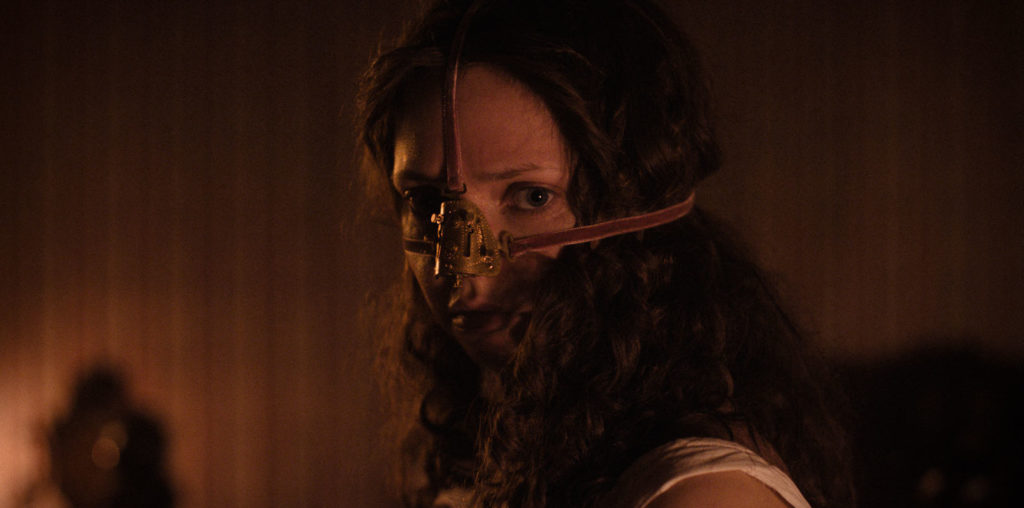
Visually, the film has some interesting moments. Gemma Doll-Grossman’s cinematography fills the frame with blues and grays, as fog-drenched forests and dimly lit interiors reinforce Henry’s isolation. A hallucinatory sexual encounter that looks oddly like a combination of drug moments from The Ipcress File and The Infinity Pool is self-indulgent, but it’s a wild sequence to watch.
Bury Me When I’m Dead is an ambitious first feature, one that aims to transcend conventional horror. The work succeeds more strongly than the abysmal In a Violent Nature or Skinamarink, both of which attempt to pack a story in a new wrapping, yet fail to give the audience a way to unwrap them. The strength here lies in the atmospheric visuals and the actors, who excel with the dialogue. While the pacing issues and underdeveloped protagonist do prevent this from reaching a transcendent sense of dread, there are a few creeps to be had.

"…an ambitious first feature..."