Directed by Frank Packard, Abar, the First Black Superman, is a bold entry in the Blaxploitation genre that mixes social commentary with superhero fiction. The story follows Dr. Kinkade (J. Walter Smith), a brilliant African-American scientist, who creates a superpower serum to fight against the racism his family faces in their new white neighborhood and beyond.
In Abar, the First Black Superman, Dr. Kinkade (J. Walter Smith), an African-American scientist, moves his family into the upscale white neighborhood of Meadow Park in hopes of a better life. However, their arrival is met with intense hostility from the white residents, who organize protests and attempt to force them out through bribes and legal threats. Unknown to everyone (even his family), Dr. Kinkade secretly works in his home laboratory on a serum that could grant superhuman abilities. His problem is finding the right person worthy of such great power.
Hearing about the trouble Dr. Kinkade has found himself in, Black activist John Abar (Tobar Mayo), the leader of the Black Front of Unity (BFU), a militant yet non-violent civil rights group, comes to the Kinkade home with a large biker gang to protect his family. Skeptical of Kinkade’s intentions and wary of putting his men at risk, he urges the doctor to leave the hostile neighborhood. But when Kinkade is attacked by local thugs and Abar heroically intervenes, the doctor identifies Abar as the perfect candidate to test his experimental superpower serum.
The story escalates when tragedy strikes the Kinkade family as a white protester kills son Tommie. Abar, now enhanced with superhuman strength, becomes the community’s protector. But wielding such power has its advantages and disadvantages, questioning whether the world is ready for Kinkade’s work.
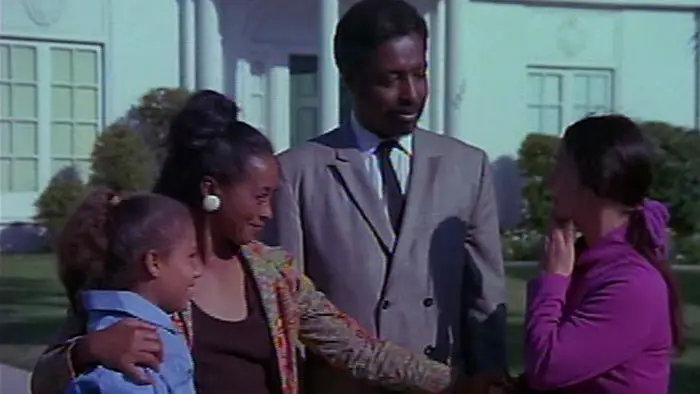
Dr. Kinkade (J. Walter Smith) and his family meet their new neighbors in Abar, the First Black Superman.
“Dr. Kinkade secretly works in his home laboratory on a serum that could grant superhuman abilities.”
Superman is not outside the boundaries of the Blaxploitation genre. In the late 70s, White America still feared the invasion of the Black neighbor. The N-word was still a part of everyday vernacular. Abar is set up as the heroic Civil Rights leader quoting the Rev. Martin Luther King, Jr., in every speech and at every learning moment. The fight was for integration and equality. Abar is even upset with Black elected politicians who do nothing for their community until it’s time to gather votes.
Like all Blaxploitation movies, there’s not a lot of money behind Frank Packard’s venture into the world of Superheroes. While the film’s title throws around the word Superman, it is in virtue only. In fact, Abar doesn’t get his powers until the third act when Dr. Kinkade’s son is killed. Due to its small budget, Abar’s power is primarily telepathic in nature, allowing him to open the eyes of the lost. Think Professor X without the wheelchair.
Abar, the First Black Superman, is there for the fans of Blaxploitation. It’s not for the kids and has a lot of edge, featuring scene after scene of racial tension that no one would dare put into the movies today. Our hero, Abar, is cool as ice, and the villains are over-the-top racist. The nugget of gold comes in the conversations about power—super or otherwise. It’s a worthy addition to your journey through the great library of Blaxploitation movies.
In the end, Abar, the First Black Superman, uses its low-budget superhero premise to address real-world issues of racial injustice and Black empowerment. While the special effects are almost non-existent, the film’s message about standing up to hate remains clear. It’s a unique chapter in Blaxploitation cinema, offering a glimpse of what happens when the struggle for equality meets the imagination of superhero storytelling.
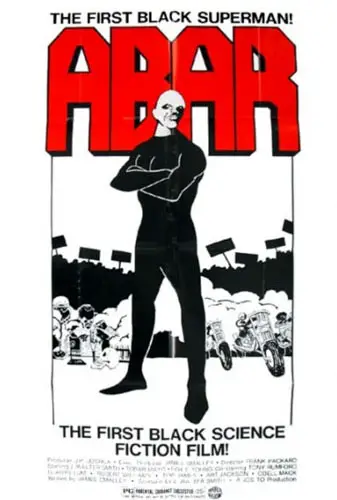
"…Scene after scene of racial tension that no one would dare put into the movies today."